

Every student comes to the classroom with an incredible capacity to learn. When we understand how the brain builds knowledge and makes meaning, we can create learning experiences that nurture curiosity, build confidence, and deepen understanding. Exploring the brain’s learning systems helps us design instruction that meets students where they are and propels them forward.
More than ever, forward-thinking educators are looking to rethink and transform traditional models of instruction. By understanding how the brain actually builds, connects, and applies knowledge, we can design learning environments that promote deeper thinking, stronger engagement, and lasting comprehension.
This path toward deeper understanding is guided by four neural subsystems that shape how students learn best:
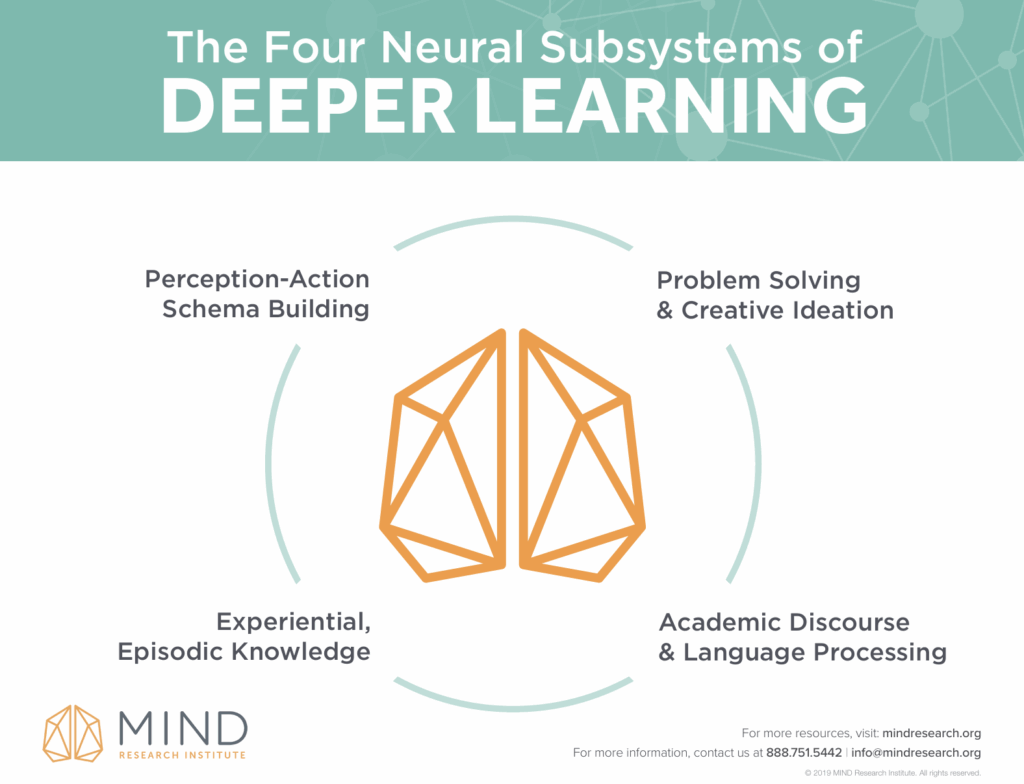
Not only do these methods bring a much higher level of student engagement, but science tells us that these instructional strategies actually activate a deeper and more rigorous learning process in the brain.
1. Perception-Action Schema Building
Most of the brain is devoted to building the circuitry responsible for the things we know automatically, says Dr. Peterson, like how we answer the question, “What color is grass?”
Our response is immediate: green.
The brain builds this kind of automatic knowledge through a continual cycle of perceiving or detecting something, taking an action and then experiencing the immediate effects of that action: the perception-action cycle.
The brain consolidates this knowledge into interconnected webs of understanding called schemas. In math, it takes time to form these foundational schemas through repetition and mastery. There aren’t any shortcuts to building schemas, because then we are relying on our working memory, which has a limited capacity.
Once formed, these schemas provide a powerful framework of knowledge that allows students to go deeper and think critically and creatively around a topic.
2. Experiential, Episodic Knowledge
In contrast to perception-action schema building, which requires repetition and time, there’s a kind of learning that happens instantaneously. One vivid, memorable experience can create lifelong knowledge.
This type of learning occurs in the hippocampus and results from experiences that are emotionally or physically impactful: stories with compelling characters, field trips, travel, and other rich activities. These highly engaging experiences present powerful learning opportunities that students naturally gravitate toward and remember.
3. Problem Solving & Creative Ideation
The front part of the brain, the pre-frontal cortex, uses the experiential knowledge and perception-action schemas that we’ve built to think over space and time, to perform multistep problem solving, and engage in creativity and ideation.
To activate this part of the brain, students should be confronted with problems where there are no step-by-step instructions.
Here, students are moving beyond repetition and automaticity of mathematical facts into applying those facts in new and novel situations, even across academic subject areas.
4. Academic Discourse and Language Processing
It is often said that you don’t truly understand something until you’ve had to explain and justify your reasoning.
Core language subsystems occur in various parts of the brain, including regions responsible for comprehension and speech production. These systems rely on all the other learning subsystems: schemas, experiential knowledge, and the prefrontal cortex’s capacity for creativity and problem solving.
We want students to practice creating sequences of rational thought that lead to a conclusion. Even if the sequence or conclusion is incorrect, this practice is essential for developing the ability to engage in academic discourse.
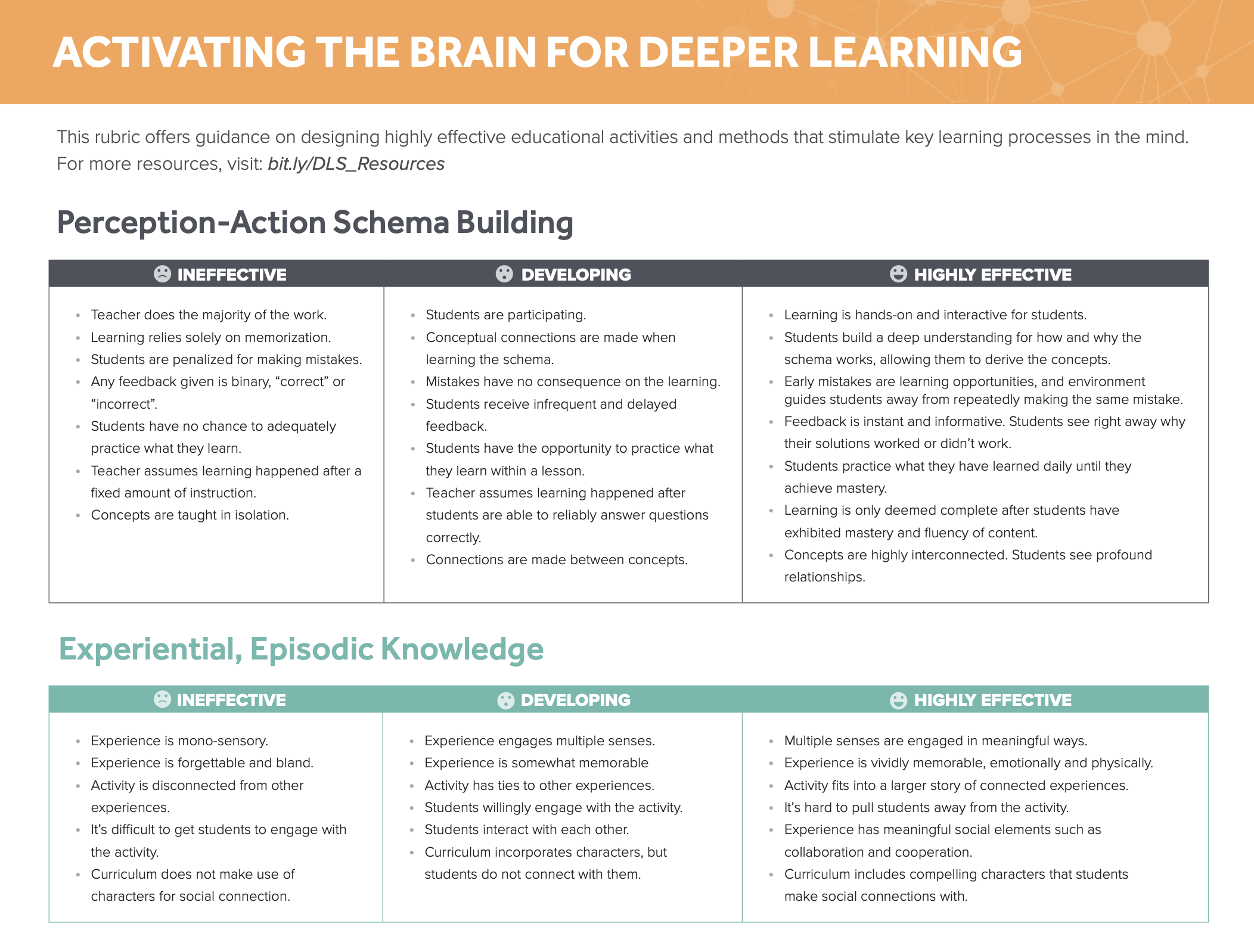
Activating the Brain for Deeper Learning
This rubric provides guidance in optimizing and innovating educational environments for developing each of these four neural subsystems.
Supporting all four neural subsystems helps us create learning environments where students feel capable, curious, and motivated. By aligning instruction with the science of how the brain learns, we help every learner build lasting understanding and confidence.
Interested in seeing brain-based learning in action? Learn more about ST Math here!