The Math Education Blog Empowering Educators to Build Problem Solvers
Research and Outcomes
Rethinking Math Education
Teaching Math to Students with Disabilities: Why Instructional Design Matters
By Ashley Jacobsen
The Real Barrier in Math Class Isn’t Ability. It’s Instructional Design.
In too many math classrooms, students with disabilities are perceived as struggling because of ability. But research — and lived classroom experience — suggest something different: often, the barrier is not the learner. It’s the learning environment.
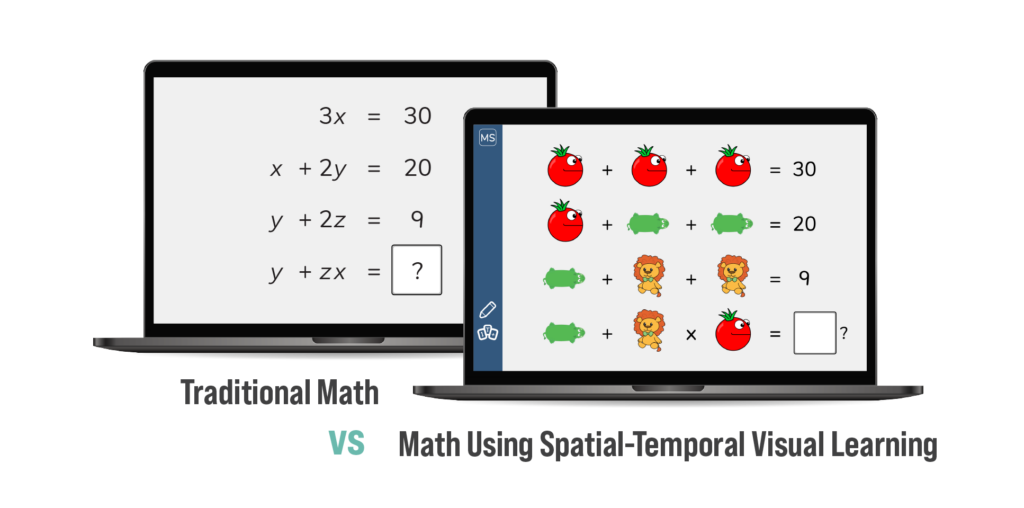
Traditional math instruction frequently begins with language-heavy explanations and abstract symbols before students have the chance to reason, explore, or see relationships. For many learners — including those receiving special education services — that sequence can create unnecessary cognitive load and block access to thinking.
When access disappears, engagement often follows.
But what happens when we change the design?
Access Changes What Becomes Possible
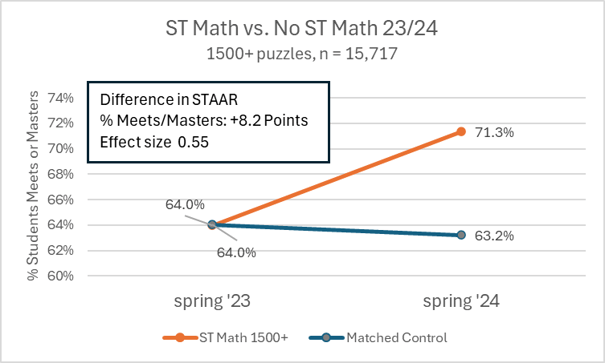
Across large-scale analyses, when barriers to access are reduced, students receiving special education services engage, persist, and make measurable progress at rates comparable to their peers. Recent national analyses of ST Math classrooms show that when students with disabilities receive sufficient puzzle engagement, their effort and learning growth closely mirror that of their peers.
The shift isn’t about lowering expectations. It’s about removing unnecessary obstacles so students can demonstrate what they understand.
As Professional Learning Specialist Janna McIntyre shared:
During a kindergarten puzzle talk, one student receiving special education services struggled with the drawing portion and became understandably frustrated. When we switched to a game mat and cubes, the student modeled the correct answer immediately. It was such a powerful moment of access.
That moment, when access replaces frustration, changes the trajectory of learning.
Notice what changed: not the standard. Not the rigor.
The entry point.
Seeing Strengths More Clearly
Superintendent Dr. Megan McNamara describes the broader systems impact:
Most subjects are literacy-heavy. But when we focus only on traditional literacy, we risk overlooking students’ real potential. ST Math helps us see their strengths more clearly. It moves our work forward. We want every student to be on equal footing.
When math is designed visually — allowing students to see, act, and receive feedback before abstract symbols dominate — educators gain clearer insight into conceptual understanding.
As Dr. McNamara explains:
We don’t have to set anything up. The program meets students where they are. It takes the lift off of teachers, it takes the stress off the student, and it puts us in a position to analyze whether the student understands conceptually or not. It’s a key part of understanding how the student learns.
Design matters. It reveals strengths that language-heavy instruction can obscure.
When Access Becomes a Safe Place for Thinking
For some students, access isn’t just instructional, it can be emotional.
Brandi Beal, a data coordinator, shared:
One student is autistic and nonverbal. ST Math is their safe place. They’re behind in grade level, but we see steady progress. With ST Math, we can clearly see that growth.
Safety and access go hand in hand. When students can engage without language barriers overwhelming working memory, they can focus on reasoning rather than decoding instructions.
Parent Katherine Hamilton describes the impact in deeply personal terms:
My child with autism struggles with communication and language at times. ST Math provides an opportunity for him to focus on foundational conceptual math understanding through the visual puzzles of ST math, without the cognitive load of language. Each puzzle he progresses through builds his confidence.
Importantly, this isn’t about simplifying math. It’s about honoring neurodiversity.
Inclusion is not a separate track. It’s a thoughtful design.
Autistic brains are amazing, and yet they are different from neurotypical brains. ST Math honors, encourages, and helps build the idea of an inclusive classroom through the ‘multiple perspectives’ that the puzzles show.
Katherine Hamilton, Parent
When Language Masks Understanding
One educator shared a powerful example of how language can mask understanding:
ST Math was a game changer for an echolalic student. The spoken language of math had created a ‘log jam.’ But when we introduced them to ST Math, which had no spoken language in which to ‘echo,’ they flourished. We later discovered that their mathematical understanding was actually at the 6th grade level, when we had originally thought it was at the 2nd grade level.
The student’s ability didn’t change.
The environment did. The access did.
And when the barrier of spoken language was removed, deep conceptual understanding surfaced.
Inclusion by Design
When math instruction begins with students making sense of what they see and experience rather than symbolic abstraction, access expands. When access expands, engagement becomes visible. When engagement becomes visible, progress follows.