

What if you went to bed on October 4th and woke up on October 15th? Or discovered that certain numbers were considered so unlucky that entire buildings avoided them?
This fall, we’re uncovering some of math’s strangest mysteries and sharing fun, hands-on activities to bring a little spooky problem-solving into your classroom or home.

Photo by Rudolf Viktor Janic via Canva. Originally sourced from Pexels.
The Curious Case of the Missing October Days
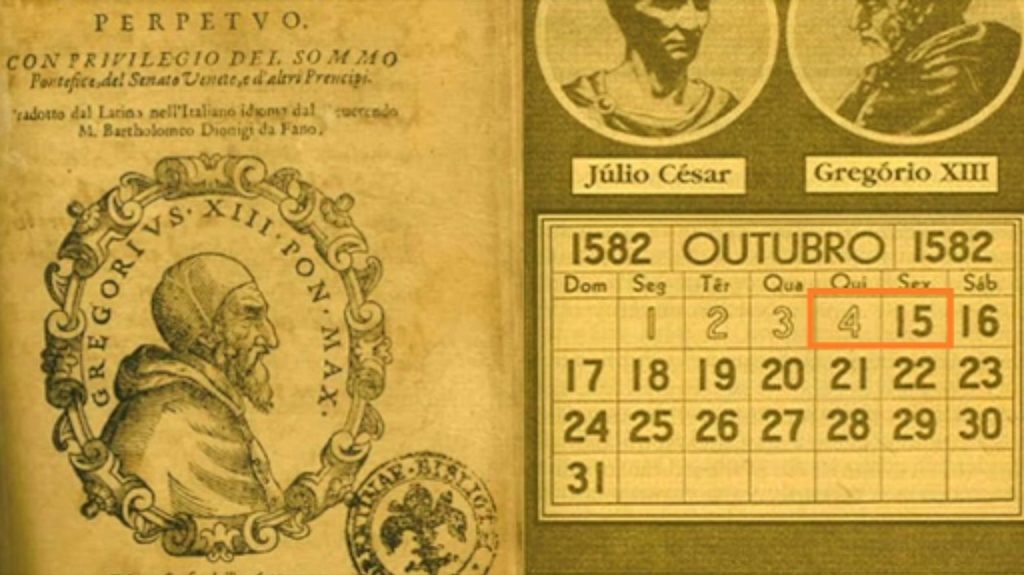
In October 1582, something strange happened. People in several European countries went to bed on October 4th and woke up the next morning on October 15th. Ten days vanishing into thin air? Actually, it wasn’t a trick or a supernatural occurrence. It was math.
For centuries, much of Europe followed the Julian calendar, which calculated the length of a year as 365.25 days. But the actual solar year is approximately 365.2422 days long. That tiny difference added up over centuries, causing the calendar to drift out of alignment with the seasons.
Calendar image courtesy of CCB Estudos.
To fix the problem, Pope Gregory XIII introduced the Gregorian calendar. Countries adopting the change in October 1582 skipped ten calendar dates, jumping directly from October 4th to October 15th.
What curiosities those ten missing days could have held, history will never know.
Can your students crack the case?
October usually has 31 days. If ten calendar dates were skipped, how many dates did October 1582 have in those countries? Answer: 21 dates!
Thankfully, no actual time disappeared; that would be a little more difficult to answer by the way of math. But the curious case of the missing October days reminds us that mathematics helps us measure and make sense of the world, even something as familiar as our calendar.
Very Superstitious: Spooky Numbers
Missing dates aren’t the only numerical mysteries hiding in history. Across the world, certain numbers have earned some surprisingly spooky reputations.
Unlucky Number 13
In many Western cultures, 13 is considered unlucky. Some hotels and skyscrapers even skip the 13th floor, labeling it as the 14th instead.
And then there’s the hallmark superstitious date: Friday the 13th. A date so notorious that it’s inspired countless beliefs and scary stories.
But here’s a surprising mathematical fact: Every calendar year has at least one Friday the 13th, but some have as many as three!

Photo by Emily Bernal on Unsplash.
The Frightening Number 4
In parts of East Asia, the number 4 is associated with bad luck because its pronunciation sounds similar to the word for death in several languages.
This superstition is sometimes called tetraphobia. Just as some Western buildings skip floor 13, certain buildings in East Asia omit floor numbers containing 4.
Try this number challenge:
Imagine a building that skips the number 4 and every floor number containing the digit 4. If you’re standing on the floor labeled 15, how many floors above the ground have you actually traveled? Answer: 13 floors!
While numbers themselves aren’t lucky or unlucky, these superstitious number stories show how mathematics, language, and cultural traditions can intersect in unexpected and interesting ways.
Bring the Halloween Math Fun to Life!
Now that we’ve explored disappearing dates and mysterious numbers, it’s time to put those problem-solving skills to work!
Whether you’re planning a classroom celebration, looking for a fun activity to send home, or wondering what to do with all that leftover Halloween candy, these five activities offer creative ways to keep students thinking mathematically during this season.
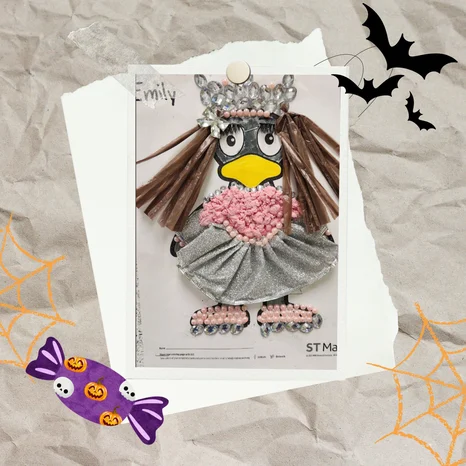
1. Have a JiJi Halloween Costume Contest
JiJi is getting ready for fall festivities and needs some costume inspiration!
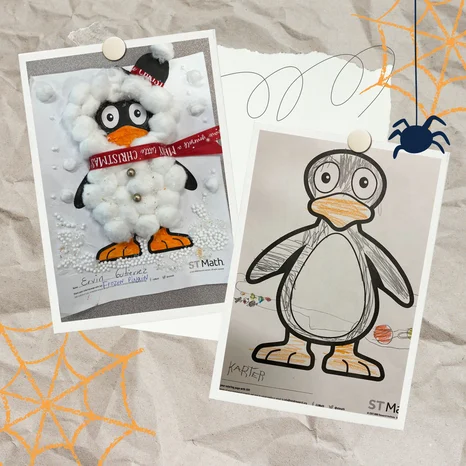
Invite students to design their own costumes for JiJi using our printable template. Keep it simple with crayons and markers, or get creative with construction paper, felt, ribbons, yarn, and other craft supplies.
Once the costumes are complete, host a classroom costume parade or display everyone’s creations.
Bonus math connection: Encourage students to incorporate geometric shapes, repeating patterns, or symmetry into their designs.
And remember to share with us on social media! Make sure you’re following us on Twitter OR Instagram. Take a look at what students have come up with in the past!
2. Halloween Candy Math Memory Game
Still have leftover Halloween candy? You might want to throw it into your pantry for a rainy day—but you can also turn your candy collection into a math memory game!
All you need are individually wrapped candies, blank sticker labels, and a marker.
Write a math equation on one label (such as 3 × 2) and its answer (6) on another. Attach the labels to separate pieces of candy, then arrange them face down.
Students take turns flipping over two candies at a time, trying to match each equation with its correct answer. Students can also set a timer and attempt to beat their own record.
This activity can easily be adapted for addition, subtraction, multiplication, or division.

Photo by Denny Müller on Unsplash
3. Scary Numbers Storybook
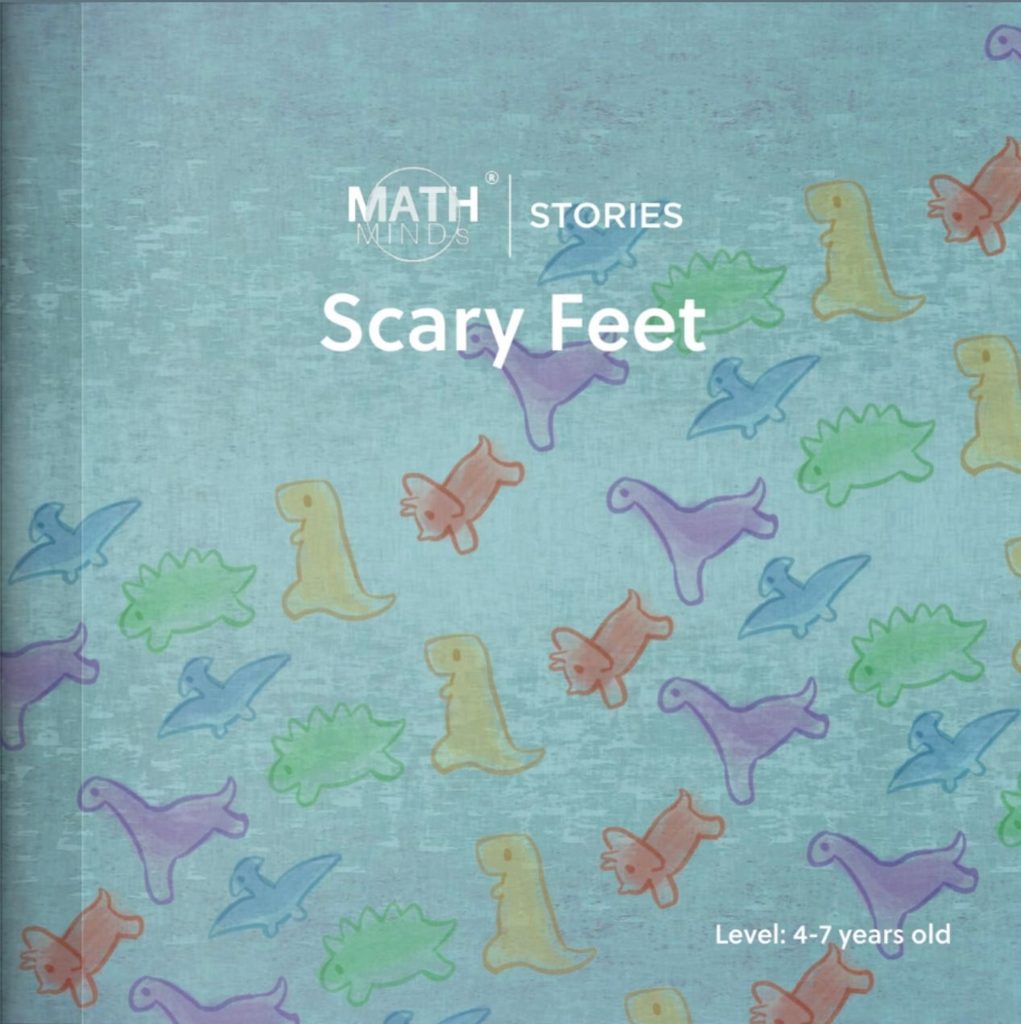
If cows could talk about numbers, which number would frighten them the most?
Find out in Scary Numbers, an interactive MathMINDs storybook that takes young learners on a journey into prehistoric Lesotho.
Designed for Kindergarten and first-grade students, this engaging story invites children and families to explore numbers through storytelling and mathematical discovery.
It’s a fun choice for classroom read-alouds or family math time. Try Scary Feet yourself!
4. Guessing Game Math Activity
Before the Halloween candy disappears, grab a scale, a pencil, and some paper for a simple estimation challenge.
Ask students to predict how much their candy bag weighs before checking their answers on a scale.
Or, have them estimate how many individual pieces of candy they’ve collected before counting them.
For an extra challenge, combine several candy collections and estimate their total weight or number of pieces.
Ways to keep the math conversation going: How close was your estimate? What strategy did you use? How could you make a more accurate prediction next time?
5. Pac-O-Lantern Coloring Sheet
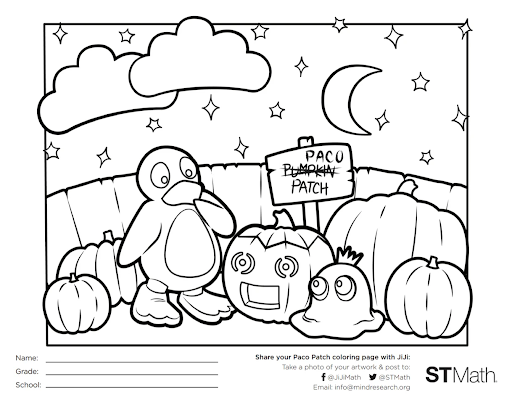
Looking for a quieter fall themed activity? JiJi has made a spooky discovery at the Pumpkin Paco Patch!
At first glance, JiJi spots a ghost. But look closer, and you’ll find Paco dressed in costume alongside a friendly Pac-O-Lantern.
Print out the coloring sheet and invite students to bring the scene to life with crayons, markers, or their favorite art supplies.
It’s a simple activity for classroom celebrations, early finishers, or a little Halloween creativity at home.